Romanisti · Observation
A River Crossed Twice
Attilio Ferraris left Roma, crossed the river, and eventually came back to where he belonged.
Attilio Ferraris was born in Rome, in 1904, though sources genuinely disagree on the exact date. His family lived in Borgo, the old working quarter pressed directly against the Vatican’s outer wall.
His father, Secondo, had eight children, four of them sons, and every one of the boys played football. Attilio was the youngest and, by every account, the most gifted. Three older brothers, Paolo, Gino, and Fausto, had already been known on the same local pitches, which made Attilio the fourth footballing Ferraris and gave him the name that would follow him through his career: Ferraris IV. Rome eventually supplied another. In the dialect of his neighborhood he became Er Più de Borgo, roughly, the best of Borgo. One name distinguished him from his brothers. The other distinguished him from nearly everyone else.
He started at Fortitudo, one of the three clubs folded together in 1927 to form AS Roma, and was already its captain and a genuine local idol well before the merger happened. When Roma played its first national championship match that September, Ferraris wore the captain’s armband. Rome did not need to invent a representative for its new club. It had, in effect, already found one.

Italy national team, Bologna, 29 May 1927. Wikimedia Commons, public domain.
What followed was a career of real and well-documented indiscipline. Ferraris smoked and drank heavily, gambled on horses, dogs, and cards, and developed a reputation for treating training as something rather less urgent than his managers did. By the spring of 1934, the conflict had become impossible to contain. After a confrontation with club president Renato Sacerdoti, Ferraris was suspended for insubordination and disappeared from the Roma side.

Attilio Ferraris IV. Wikimedia Commons, CC0 1.0.
It was Vittorio Pozzo, the national team’s manager, who went looking for him before that summer’s World Cup. The story sounds almost designed for the man it concerns: Pozzo found Ferraris in a Roman tavern and offered him a place in the national team on the condition that the cigarettes, alcohol, billiards, and neglected training stop. Ferraris agreed. When he reported to Italy’s training camp, Pozzo later recalled, he arrived in better condition than anyone else. Ferraris became one of the outstanding performers as Italy won the 1934 World Cup on home soil. Months later, at Highbury in November, his physical performance in Italy’s famous and brutally contested 3–2 loss to England helped attach another name to him: the Lion of Highbury.
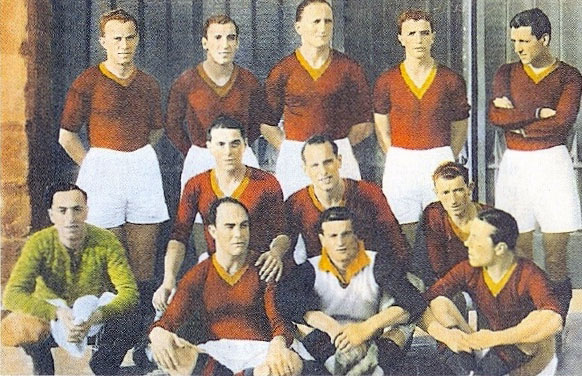
AS Roma, 20 December 1931. Guerin Sportivo Photo Archive / Lamberto Bertozzi Collection. Wikimedia Commons, public domain.
By then, however, the relationship that had made him Roma’s first captain had broken apart. In August 1934, Ferraris left Roma for the capital’s other club.
The rupture with Roma is clear enough. The precise reason Ferraris crossed the river is less so. His indiscipline and confrontation with Sacerdoti plainly belonged to the story, but contemporary and later accounts have supplied different mixtures of resentment, money, opportunity, and revenge to explain what happened next. The disagreement is probably more useful than a cleaner answer would be. A man Rome had built into one of the founding symbols of its new club crossed the river, and Romanisti did not need to settle the motive before deciding what they thought of it.
A few months later, they had the opportunity to tell him.
Ferraris returned to Testaccio in November wearing the other colors. The reception was exactly what might be expected. The whistles came down from the Roma supporters, together with a single accusation: venduto. Sellout.
Then Fulvio Bernardini walked across the pitch.
Bernardini had been Ferraris’s teammate and considered him something closer to a brother. In front of the crowd, he took Ferraris by the head and kissed him on the forehead. The whistles turned to applause.
Ferraris had not come home. He was still standing there in another shirt. But something had shifted anyway.
There is older precedent in this city for exile followed eventually by return, though the shape Rome gave that story was considerably more magnificent. According to the Roman tradition preserved most famously by Livy, Marcus Furius Camillus had captured the Etruscan city of Veii after a siege said to have lasted ten years. The victory should have secured his place among Rome’s great men. Instead, disputes over the spoils of Veii and accusations surrounding their distribution turned political opinion against him. Facing prosecution, Camillus left Rome for exile at Ardea.
While he was away, Gallic forces under Brennus sacked Rome, one of the great disasters preserved in the city’s ancient memory. With Rome facing humiliation, Camillus was recalled, named dictator and, in the traditional account, arrived as the Gauls were weighing out the ransom gold the city had agreed to pay. He rejected the settlement, defeated them, and later persuaded the shaken Romans not to abandon their ruined city. Roman memory eventually made him the Second Founder of Rome.
It is almost too perfect a story of return, which is one reason to be careful with it. The surviving accounts were written centuries after the events they describe. Modern historians dispute the conventional chronology, and some of the most memorable details, the gold on the scales, the perfectly timed arrival, Camillus driving the Gauls from Rome, bear the fingerprints of later Roman legend-building. But that is also what makes the story useful here. Rome remembered exile and return in the grandest terms available to it. The man cast out came back at precisely the moment the city needed him, saved it, and became greater in memory because he had once been sent away.
Ferraris’s own return, when it finally came, sadly looked nothing like that.
He spent two seasons across the river, two more at Bari, and then, in 1938, came back to Roma for a single final season. He made twelve league appearances. There was no recall from dictatorship, no army, no ransom gold, no city waiting breathlessly for him to save it. There was simply a thirty-four-year-old former captain, past his best, playing out a quiet final year in the colors he had started in before moving on to Catania and eventually to the amateur side Elettronica Roma.
If Camillus represents the version of return Rome taught itself to remember, Ferraris offers something closer to the way return usually happens. There was no single moment in which the old rupture was repaired. Perhaps it had begun four years earlier, when Bernardini crossed the pitch at Testaccio and kissed him on the forehead. Perhaps twelve appearances in 1938 were enough. Nobody declared the matter settled. Roma simply put its first captain back in its shirt.
Ferraris eventually moved to Montecatini Terme in Tuscany, where he continued to play football informally. On May 8, 1947, at forty-three, he collapsed on the pitch during a match among old friends and died of an apparent heart attack.
He was not in Rome when it happened.
The city that had made him its new club’s first captain, watched him become a world champion, condemned him when he crossed the river, applauded him while he was still wearing the wrong shirt, and eventually accepted him back for one unremarkable final season learned of his death from somewhere else.
Rome’s relationship with the men it elevates has rarely followed a single template. Ancient Rome gave itself Camillus, a story in which exile was redeemed by return so completely that the departure became part of the legend. Ferraris left behind something less convenient. Nothing he did after 1934 erased the fact that Roma’s first captain had crossed the river. Nothing about crossing the river erased what he had been before it.
Perhaps that is what Bernardini understood at Testaccio. Ferraris was standing in the wrong colors when his old teammate crossed the pitch and embraced him. The crowd that had been whistling applauded. Nobody had forgotten what Ferraris had done. They simply discovered, for a moment, that anger and affection could occupy the same ground.
Four years later, he came back. There was no grand reconciliation because none was required. Twelve appearances could not undo his departure, and his departure could not undo everything that had come before it. Ferraris had been Roma’s first captain. He had left. He had crossed the river. And still, somehow, he belonged.
Sources consulted: Attilio Ferraris, ASR Talenti; “Attilio Ferraris IV, il primo capitano della Roma,” Hall of Fame, Il Romanista; “A volte aveva solo bisogno di una parola,” Il Nobile Calcio; “Attilio Ferraris IV, il gladiatore di Highbury,” Incontro Piede; Ferraris (IV) Attilio, LazioWiki; Attilio Ferraris, Find a Grave; “Capitani della Roma: Attilio Ferraris IV,” Unfolding Roma; Ferraris Attilio, Wikisport; Attilio Ferraris, Wikipedia; AS Roma Hall of Fame; FIFA material on Vittorio Pozzo and Attilio Ferraris; Olympedia; Storia della Roma; Marcus Furius Camillus, EBSCO Research Starters; Camillus, World History Encyclopedia; Marcus Furius Camillus, Livius.org. Wikimedia Commons file records were used to verify the identification and reuse status of the photographs. Sources differ on Ferraris’s exact birth date, the precise circumstances and motive surrounding his 1934 departure from Roma, and counts of his total appearances for the club. The account of Camillus is treated above as Roman historical tradition where the surviving ancient narrative cannot be regarded as settled historical fact.