Romanisti · Observation
The Road from Frascati
The life of Amedeo Amadei, and the ordinary things that survived an extraordinary war.
Amedeo Amadei was supposed to be delivering bread.
His father ran a bakery in Frascati, in the hills southeast of Rome, and the boy had responsibilities there. But football had begun to interest him more than the family business. One day, without telling his parents where he was going, he took his bicycle and rode into the capital for a trial with Roma. The deliveries could wait.
The nickname that followed him for the rest of his life came from the work he had left behind. Il Fornaretto, the little baker boy, was what people called him even after there was little about his football that remained small.
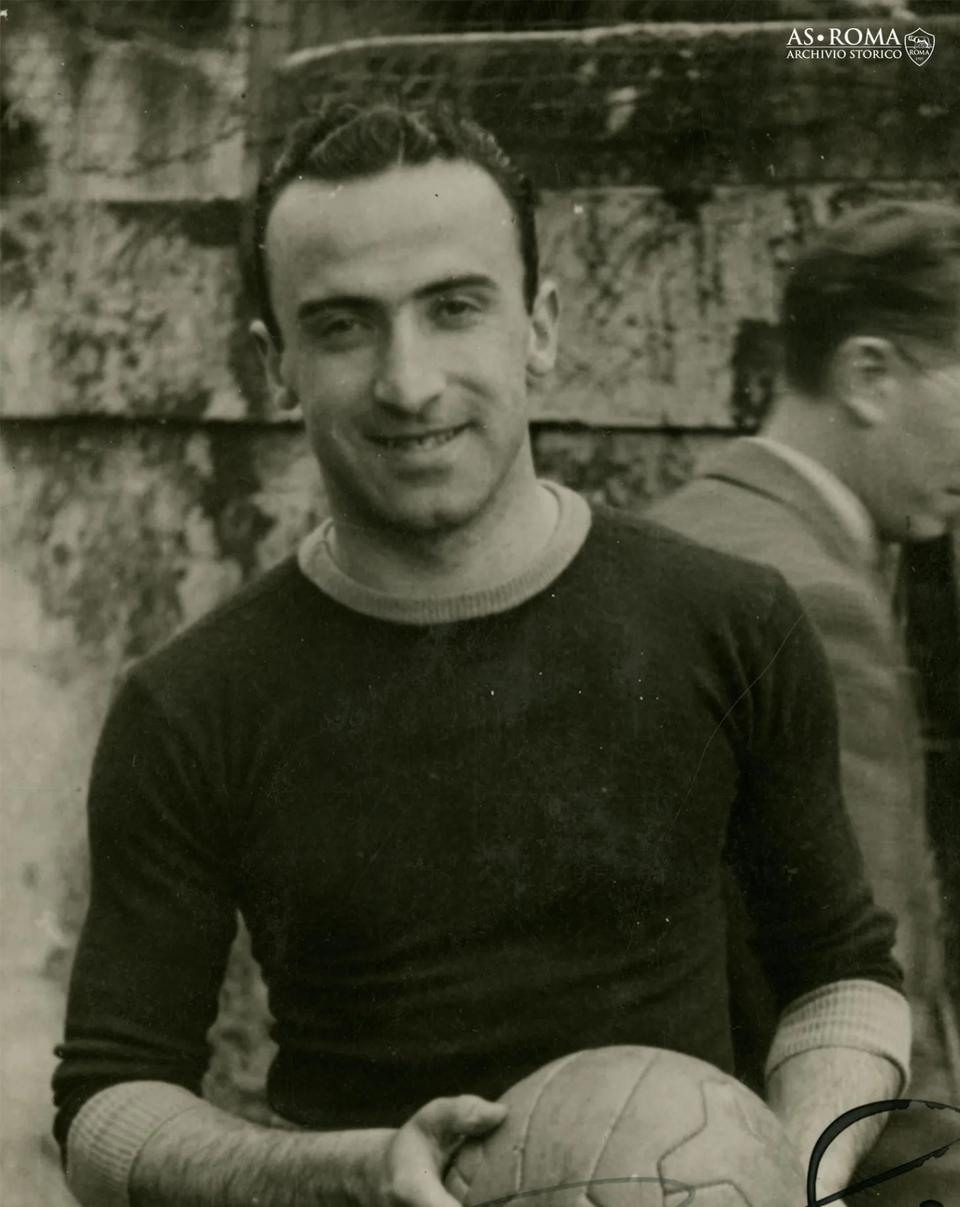
On 2 May 1937, Amadei made his Serie A debut against Fiorentina, aged fifteen years and 281 days. A week later, against Lucchese, he scored his first goal. He was fifteen years and 288 days old, an age at which most boys were still some distance from deciding what they might do for a living. Amadei had already begun one of the longest and most remarkable careers in Italian football.
He had grown up watching Roma. As a boy, he had traveled from Frascati to Campo Testaccio, where Attilio Ferraris, Fulvio Bernardini and Guido Masetti belonged to a generation of players whose names were already familiar throughout the city. Now he was sharing the profession that had once brought him into Rome as a spectator.
There was a season at Atalanta before he established himself in Roma’s first team. By 1941, he had become the center of its attack. The following year, Roma won its first Italian championship, with Amadei leading the club’s scoring. He was not yet twenty-one.
The achievement made him one of the city’s most recognizable footballers. The journalist Bruno Roghi is credited with calling him the Eighth King of Rome, a title that would eventually be bestowed upon other players, though Amadei had been its first recipient. A baker’s son from Frascati had entered a peculiar Roman tradition in which footballers occasionally acquired the language of monarchy.
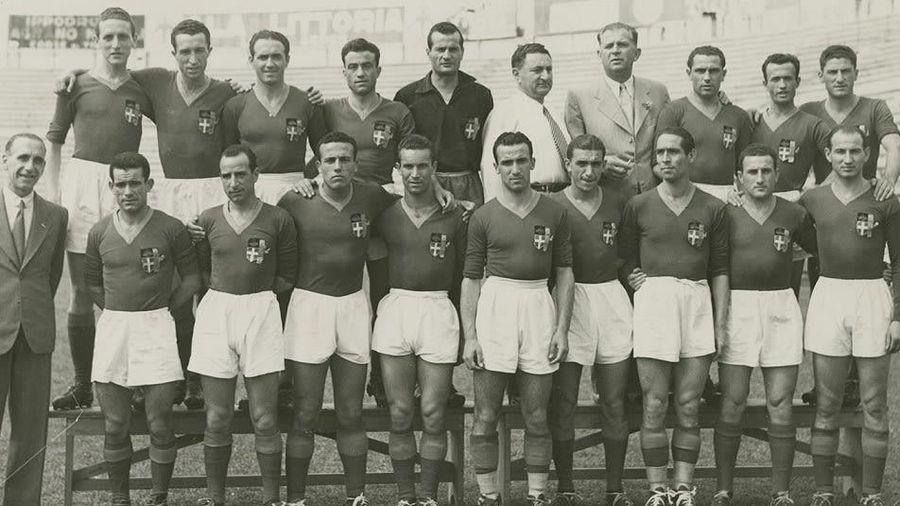
By then, Italy had been at war for nearly two years. Roma’s championship belonged to a country whose ordinary institutions were already being placed under increasing strain. Football continued, but there was little reason to assume that the conditions allowing it to continue would last.
In May 1943, during a Coppa Italia semifinal against Torino, an assistant referee was assaulted following a disputed decision. Amadei was identified as the offender and received a lifetime disqualification. The incident would remain disputed for years. In 1946, another Roma player, Vittorio Dagianti, acknowledged responsibility for the assault.
For Amadei, the immediate consequence was exclusion from the profession on which he depended.
That September, the war reached Frascati with devastating force. On 8 September 1943, Allied aircraft bombed the town, destroying buildings and killing civilians. The Amadei family’s bakery was among the losses.
Italy’s armistice was announced that same day. German forces occupied Rome, and the city would remain under their control until the following June.
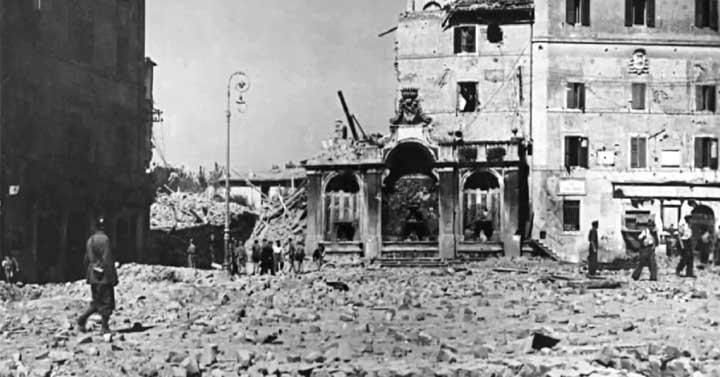
Amadei was twenty-two years old. He had a wife and a family to support, a livelihood interrupted by suspension, and a bakery that no longer existed.
In later recollections, he described traveling to Frascati early in the morning to cut wood and unloading sacks of flour at a friend’s warehouse. He also remembered seeking shelter with his pregnant wife and his mother in a small apartment near Piazza Istria after the Allied landings at Anzio in January 1944. The work was physical, the circumstances uncertain, and the distinction between the celebrated footballer and the baker’s son had become considerably less important than it had seemed two years earlier.
The city around him was living through its own disruption. Rome had been declared an open city, but that designation did not prevent occupation, arrests, deprivation or violence. The Fosse Ardeatine massacre in March 1944 left 335 people dead. Food and work were difficult to obtain, and the ordinary movement of people through the city was constrained by military circumstances.
Football had not entirely disappeared.
The national championship could no longer function as it had before the war. In its place, Roman clubs organized a local competition, the Campionato Romano di Guerra. Roma played against other teams from the city while the country remained divided and the occupation continued.
There was something familiar about the arrangement. Clubs still assembled teams, fixtures were scheduled, and people continued to follow results. Yet the familiar forms existed in circumstances that had changed almost everything around them. Players were absent, resources were scarce, and the competition could offer none of the certainty associated with an ordinary football season.
Amadei was initially unable to take part. His disqualification remained in force until an amnesty in April 1944 permitted his return. By his own account, the months away from football and the work he had undertaken had left him physically weakened.
He began playing again toward the end of April.
On 3 June 1944, Roma faced M.A.T.E.R. at the Stadio Nazionale in a semifinal of a supplementary Roman tournament. Amadei scored from the penalty spot, and Roma won 7–3.
The following day, Allied troops entered Rome.
It is tempting to make more of that football match than the surviving evidence allows. We do not know what Amadei thought about the approaching armies as he prepared to play, nor whether the players understood how close the occupation was to ending. The match was not, so far as the records establish, an organized act of political resistance.
But it happened. A footballer who had spent much of the occupation unable to practice his profession, whose family’s bakery had been destroyed, and who had been cutting wood and unloading flour to earn money, was once again playing for Roma on the day before the city was liberated.
The sequence requires little embellishment.
Liberation did not restore the city to its former condition overnight. The occupation had ended, but its consequences remained in the lives of families who had lost relatives, homes and livelihoods. Football continued within that changed city.
A tournament final scheduled for the day of liberation was eventually played on 25 June. Roma defeated Tirrenia 4–0, with Amadei scoring three times. Four days later, Roma participated in a benefit match whose proceeds helped families affected by the Fosse Ardeatine massacre. Amadei scored again.
The significance of those matches was not identical. One belonged to the continuation of a football competition; the other connected football to the immediate needs of people who had suffered during the occupation. Together, they reveal how an ordinary institution could resume familiar activities while also responding to the circumstances around it.
Amadei’s own family still had a bakery to rebuild.
He would later recall that money earned through football helped restore the business in Frascati. The reconstruction took place in the postwar years, when he was playing for Inter, but the connection was the same one that had existed before his first journey to Rome. Football was not merely something he loved or a means of public recognition. It was work, and the money it produced could repair what the war had destroyed.
The national championship resumed in 1945–46, initially in a modified format that reflected the difficulties of reuniting a country whose infrastructure had been damaged by years of conflict. Amadei returned to regular football with Roma and remained an important scorer.
The club, however, was no longer the championship-winning side of 1942. Its finances were strained, and its competitive position had deteriorated. Amadei wanted the team strengthened. Roma was in no easy position to provide the improvements he sought.
In September 1948, he joined Inter.
The departure was neither a simple rejection of Roma nor an entirely involuntary sale. The club needed money, while Amadei had professional ambitions of his own. He took part in the arrangements that made the transfer possible. The relationship between player and club had reached a point at which their interests could no longer be reconciled by affection alone.
Weeks after he left, at a Roma match in the capital, supporters began chanting his name when the team won a free kick near the penalty area. They wanted the man who had taken so many of those kicks before, although he now belonged to another club.
The affection was mutual, if not always consistent. Amadei reportedly told his subsequent clubs that he could not bear to play against Roma, comparing the prospect to harming his own mother. Yet he did face his former teammates, and in May 1954, while playing for Napoli, he scored the only goal in a victory over Roma.
There is no need to explain away the contradiction. He was a professional footballer, and Roma was no longer his employer. His attachment to the club did not prevent him from doing the work for which another club paid him. Nor did the goal against Roma erase the years that had preceded it.
Amadei played for Napoli until 1956. By the time he retired, the world in which he had made his debut had largely disappeared. Campo Testaccio was gone, Roma had moved through other grounds, and the city itself had been transformed by war and reconstruction.
He lived for another fifty-seven years.
In 2013, Amadei died at his home in Grottaferrata, aged ninety-two. His funeral was held in Frascati, where he had been born and where his family’s bakery had once stood. Former players, friends and supporters gathered to remember him. Before Roma’s next match, Daniele De Rossi laid flowers beneath the Curva Sud.
The boy who had left Frascati on a bicycle in search of a football career had spent much of his life traveling between the town and the capital. The journey had taken him through a championship, a war, a lost livelihood, its reconstruction, and a career that eventually carried him away from Roma.
In November 2013, some two thousand people gathered in Frascati for him.
Sources consulted: AS Roma historical records and Hall of Fame; FIGC; ASR Talenti; Storia della Roma; contemporary and retrospective accounts of the 1943–44 Roman wartime championship; recollections of Amedeo Amadei reproduced in the Bollettino del Gruppo dei Romanisti (2019); reporting on the 2013 funeral in Frascati. Certain archival documents and image identifications remain to be checked against original sources.