Romanisti · Observation
Seven Months a Tribune
For seven astonishing months, enough Romans accepted the invitation.
A note on method: every date, title, and event below is drawn from the historical record, cited at the close. One detail, marked clearly where it appears, was a belief Cola himself held rather than a historical fact, and is presented as such.
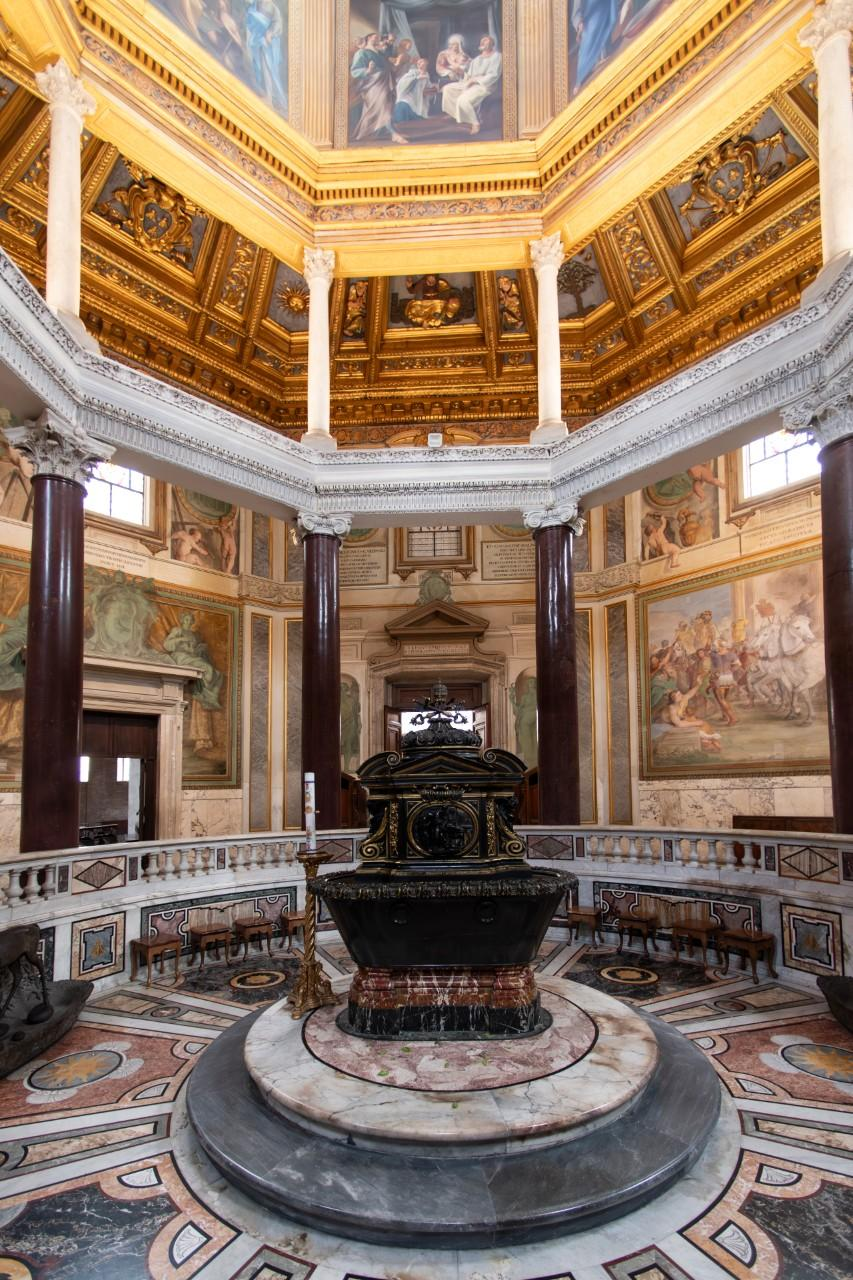
On the eve of August 1, 1347, a Roman notary named Cola di Rienzo kept vigil alone in the Lateran Baptistery, beside an ancient stone font, the large immersion basin used for Christian baptism rather than any decorative fountain. By tradition, one that Cola believed rather than one modern historians credit, the font had once held the emperor Constantine during his baptism. Whether that was actually true mattered rather less to Cola than the fact that he badly needed it to be. Before dawn, he climbed into the font and immersed himself, then had himself knighted the following morning in a ceremony of his own design, complete with a purple robe and a bare sword. He was, by trade, a man who drew up other people’s contracts. For one summer, he needed Rome to believe he was something considerably closer to an emperor’s heir.
Ten weeks earlier, his rise would have sounded absurd to nearly everyone in the city. By the time of the bath, it had already, briefly and astonishingly, come true.
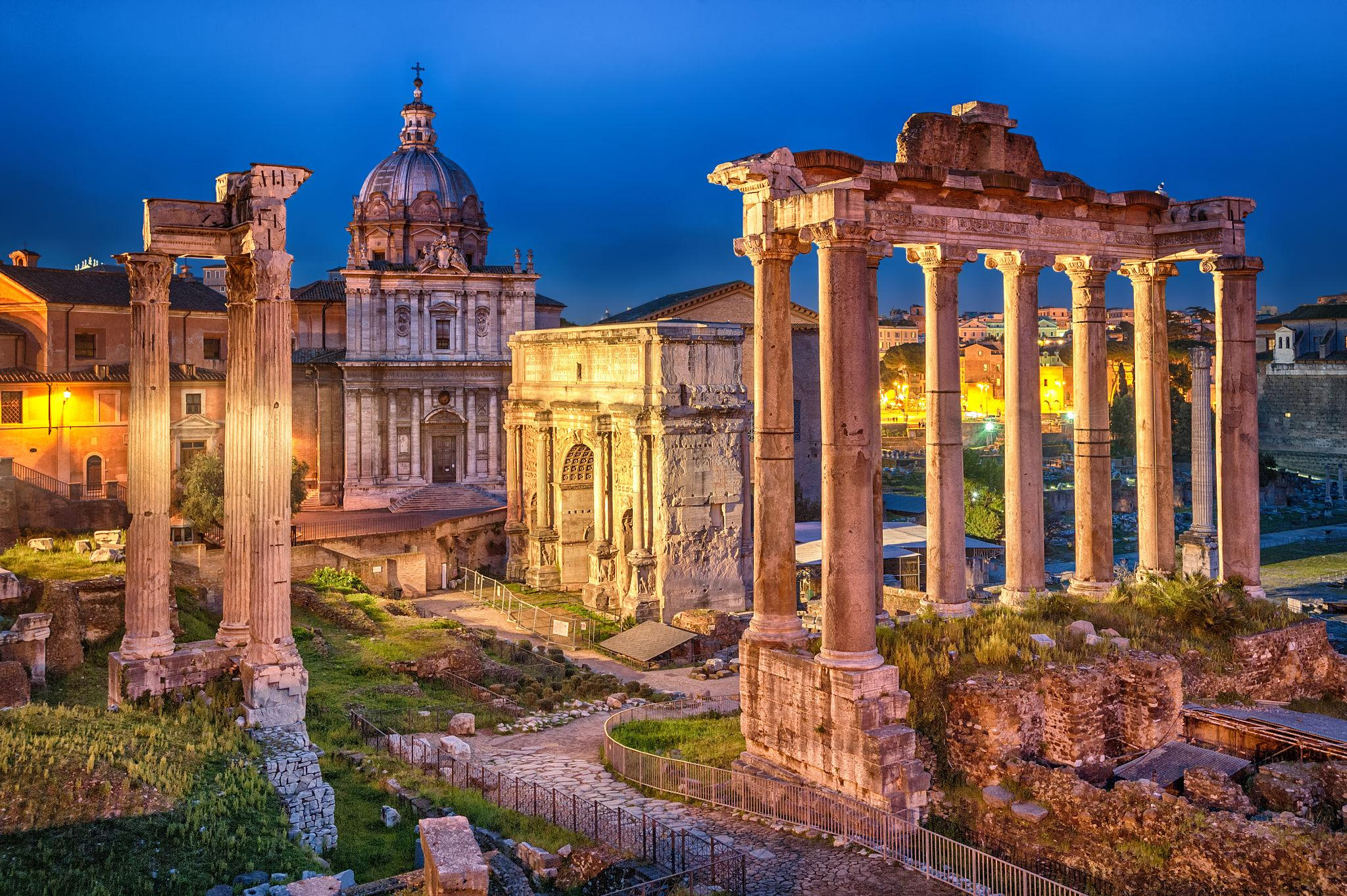
The Rome that produced Cola di Rienzo was a capital in name only. The papacy had abandoned the city for Avignon in 1309, and in its long absence a handful of noble families, the Colonna and Orsini chief among them, ran Rome as something closer to a standing private quarrel than a functioning government. The ancient monuments still stood everywhere, enormous and largely ignored, a constant physical reminder of a scale of authority the city could no longer produce on its own. It was not a coincidence, six years before Cola’s rise, that Petrarch himself had chosen the Capitoline Hill as the site of his own poetic coronation in 1341, a ceremony deliberately invoking the antique glory the hill was thought to still contain. The stage, in other words, had already been set for someone to claim it more literally.
Cola, born the son of a tavern keeper and, by some accounts, a washerwoman, was largely self-taught in classical history, and grew increasingly furious at the gap between what Rome had been and what it had become. In 1343 the city’s popular faction sent him as part of a delegation to plead its case before Pope Clement VI in Avignon, and the pope, apparently impressed, appointed him notary of the Roman civic treasury. Cola returned to Rome the following year and spent roughly three years building toward the moment he had already decided the city needed. Almost nobody with actual power took him seriously in the meantime. The city’s ordinary residents, it would turn out, did.
On May 20, 1347, Pentecost Sunday, Cola led an armed but essentially unopposed procession to the Capitoline, occupied the seat of government, and addressed the crowd gathered beneath him. There was no real battle to speak of. The nobility, caught entirely unprepared, had nothing organized with which to resist. Cola proclaimed a new government on the spot, took the ancient title of Tribune, a title that had meant nothing concrete in Rome for well over a thousand years, and announced a set of reforming laws, the Buoni Statuti, aimed squarely at the noble lawlessness that had defined the city for a generation. The crowd did not need much convincing. It had already decided, well before he finished speaking, that it wanted to believe him.
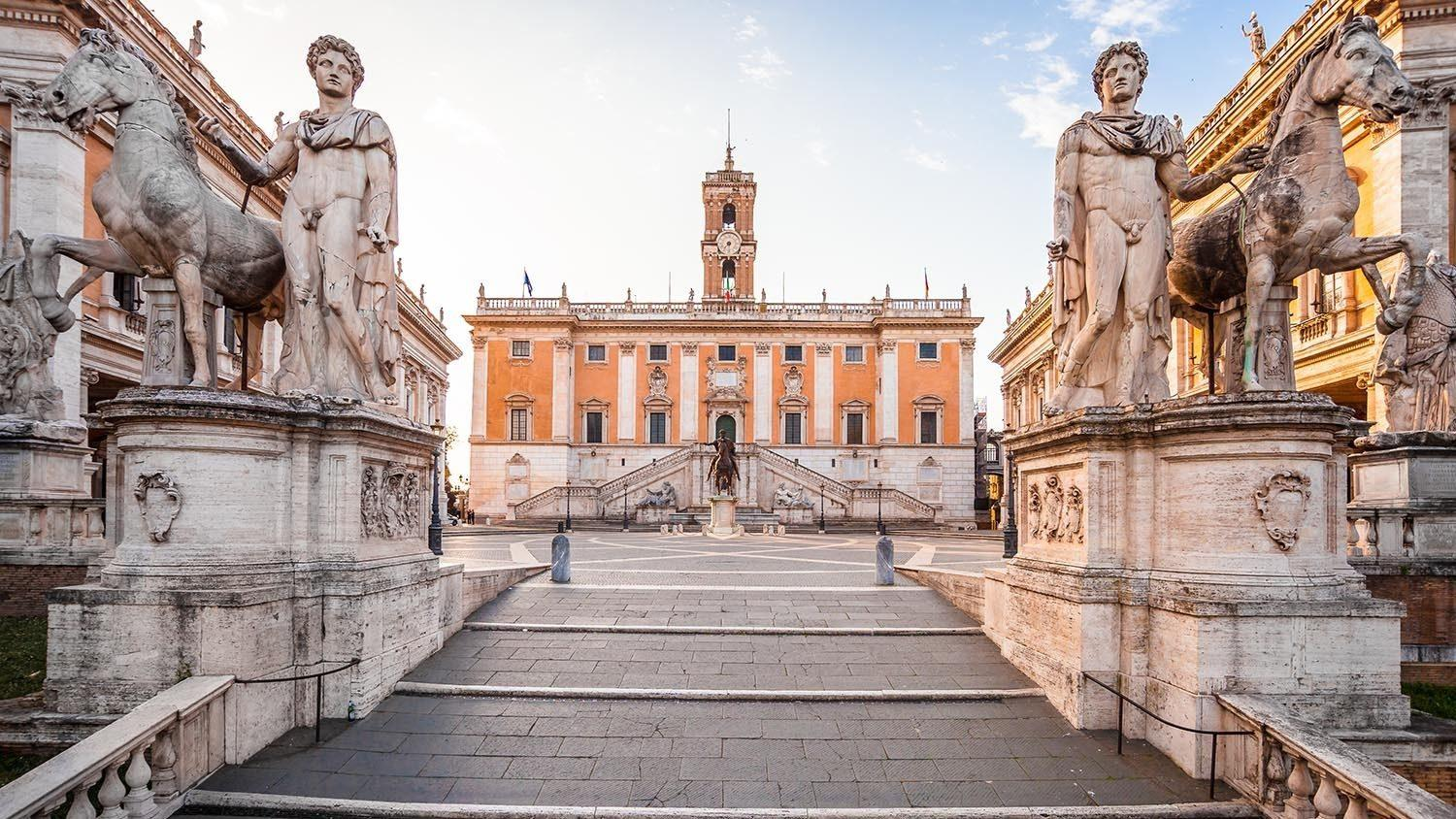
What followed was a summer of steadily escalating ceremony. Cola styled himself in language borrowed directly from the vocabulary of empire, tribune, liberator, eventually something closer to candidate of the Holy Spirit, and staged one elaborate public ritual after another to make his new authority feel physically, undeniably real. During festivities at the Lateran, according to contemporary accounts, wine was made to pour from the nostrils of the ancient equestrian statue of Marcus Aurelius that then stood outside the palace. He sent invitations across the Italian peninsula, declared Roman citizenship open to the broader population of Italy, and summoned regional representatives to an assembly meant to signal the capital’s restored primacy over the whole country. For a moment that August, an entire peninsula watched a notary’s son perform the role of an ancient ruler, and enough of Italy played along that it briefly looked like considerably more than theater.
It could not hold, and the record makes clear that it did not collapse for any single, simple reason. The ceremonies grew more grandiose precisely as the actual work of governing grew harder. Taxes had to rise to pay for what the ceremonies cost. The Avignon papacy, having watched cautiously at first, began to read Cola’s escalating claims as a rival source of legitimacy rather than a useful ally, and quietly turned against him. The exiled nobility regrouped outside the city walls, and in November Cola’s forces met and defeated their army in the field near Porta San Lorenzo, a victory in which Stefano Colonna the Younger, one of the most powerful figures in the family, was killed. It was a real win, but it steadied nothing underneath it. By mid-December, facing the threat of excommunication and a city whose patience had visibly run out, Cola abdicated and fled Rome. From proclamation to flight, seven months had passed.
Seven months is worth sitting with as a number on its own. It is not very long to build a myth around yourself, and it is a genuinely short time to lose one that thoroughly.
He did not vanish for good, though what followed was closer to a long, uneven epilogue than a comeback. He lived for a time as something like a hermit, then in 1350 traveled to Prague to seek the backing of the emperor Charles IV, who instead had him placed under guard and eventually handed over to the papacy. Cola spent nearly two years imprisoned at Avignon under sentence of death. Petrarch, still an admirer despite his growing disillusionment, appealed on his behalf. When Clement VI died in December 1352, his successor, Innocent VI, saw a use for the former tribune and had him pardoned. Sent back toward Italy alongside the papal legate Cardinal Albornoz, Cola entered Rome again on August 1, 1354, this time with the title of Senator, and was received, briefly, with genuine rejoicing.
His second term in power proved shorter than his first. A siege he launched against the fortress at Palestrina failed outright. He had the mercenary leader Fra Moriale arrested and executed, and turned increasingly to heavy taxation and arbitrary cruelty to keep his position afloat. The goodwill he had returned to did not survive the autumn. On October 8, 1354, a mob gathered outside his palace shouting for the death of Rienzi the traitor, and the building in which he tried to address them was set alight. Cola attempted to escape in a commoner’s disguise. He was recognized anyway, seized, and killed by the crowd. His body was then dragged through the streets of the city he had twice tried to restore to greatness. The site of his death sat only a short distance from the Capitoline where his rise had begun.
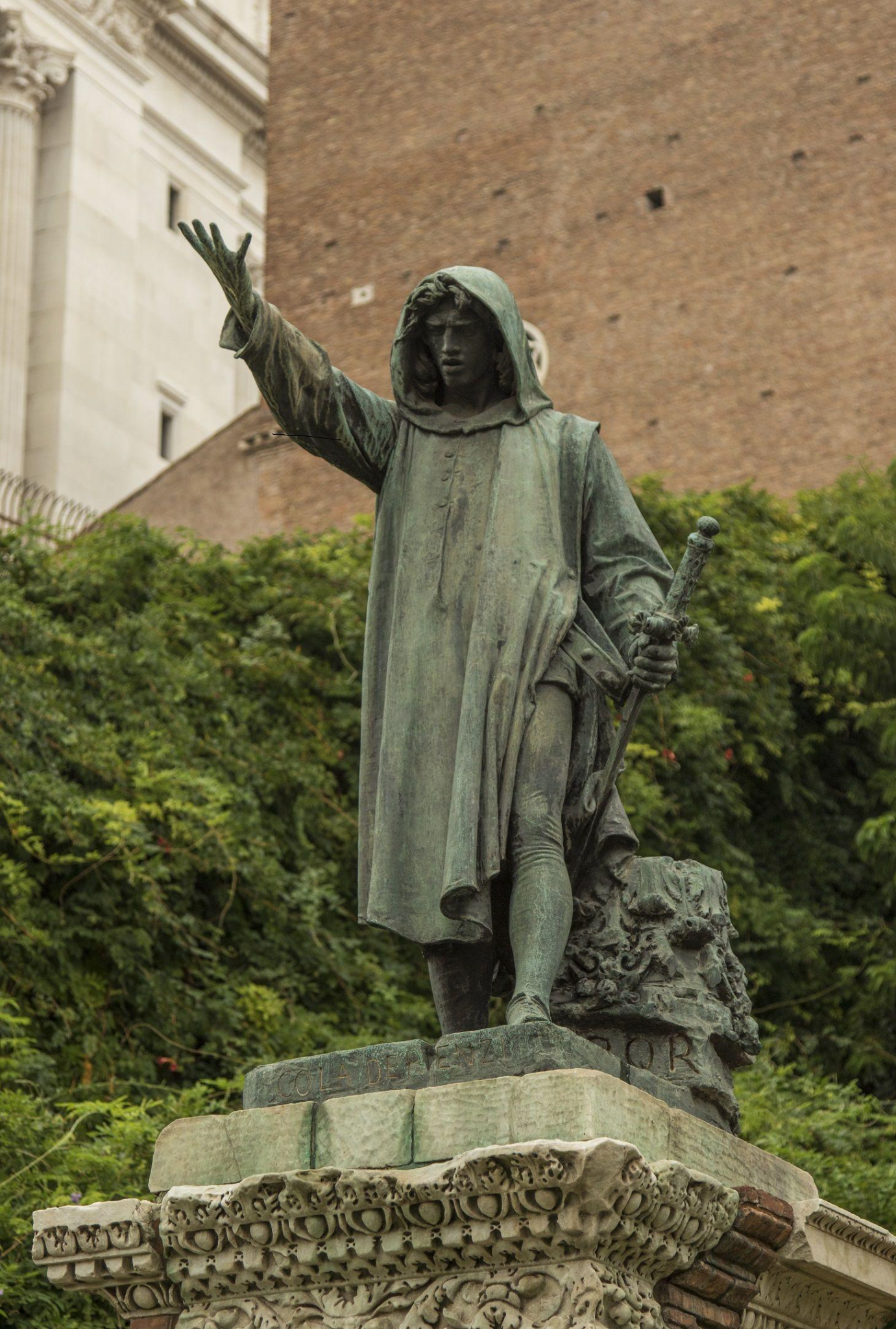
The story did not end with his body, either. Petrarch celebrated Cola in his writing. In the nineteenth century, long after the Rome he had briefly ruled had itself changed almost beyond recognition, Cola was reinvented again, adopted by Italian nationalists of the Risorgimento as an early prophet of a unified Italy, and dramatized for wider European audiences through Bulwer-Lytton’s 1835 novel and Wagner’s 1842 opera, both simply titled Rienzi. A statue of him was eventually raised near the foot of the Capitoline, not far from where the mob caught up with him five centuries earlier. Each generation that revisited his story seems to have found in it whatever it happened to need at the time, which is, in its own way, exactly the trick Cola himself had once tried to pull on his own city.
Rome did not ask Cola to become its tribune. He asked Rome to believe that he could be one. He reached into the city’s own history for the title, the imagery and the authority, then presented himself as the man capable of restoring something Rome had lost. For seven astonishing months, enough Romans accepted the invitation.
Anyone who has watched enough Roma will recognize something in the exchange. A figure arrives offering restoration, greatness, or simply the promise that things will be different now. Sometimes the promise belongs to him before it belongs to Rome. What Rome supplies is the belief, and when it comes, it can arrive with extraordinary force.
That makes the distance between acclaim and rejection more complicated than simple fickleness. Cola had asked to be measured against a Rome larger than the one around him. Every ceremony raised the measure. Every title enlarged it. Every success made the performance seem a little more plausible, until governing began to expose the distance between the man and the role he had constructed for himself.
None of this requires embellishment. The seven months were real. The vigil in the ancient font was real, whatever Cola happened to believe about whose baptism it had once held. The mob at the end was real, in almost the same place the acclaim had once been. Rome did not build Cola’s myth for him.
It did something more interesting.
It believed him.
Sources consulted: Richard Cavendish, “Cola di Rienzi Proclaims Himself ‘Tribune’ of Rome,” History Today, Vol. 47 Issue 5 (May 1997); “Cola di Rienzo Murdered,” History Today; “Cola di Rienzo,” Encyclopædia Britannica; “Cola di Rienzo,” Encyclopedia.com; EBSCO Research Starters, “Cola di Rienzo Leads Popular Uprising in Rome”; Oxford Bibliographies, “Cola di Rienzo”; Paideia Institute, “Cola di Rienzo and the Brief Return of the Roman Republic”; “Cola di Rienzo… and Mussolini?”, The Patroclus; Catholic Encyclopedia, “Cola di Rienzi”; Treccani, entries concerning Stefano Colonna and Fra Moriale; VIVE, “Cola di Rienzo: Times and People of Rome.” The belief that the Lateran font had held Constantine’s baptism is a medieval tradition associated with Cola, not a historical fact.