Romanisti · Observation
Founded Before It Was Founded
Rome already had its history. Roma gave that inheritance somewhere new to go.
On Via Galvani in Testaccio, a few blocks from where Campo Testaccio once stood, there is a wolf several stories tall. The Belgian street artist ROA painted her across the facade of a residential building in 2014. She is not La Lupa of postcards and souvenir shops. She is lean, almost gaunt, caught mid-leap in black and white, more animal than monument, and startling even in a city crowded with wolves.
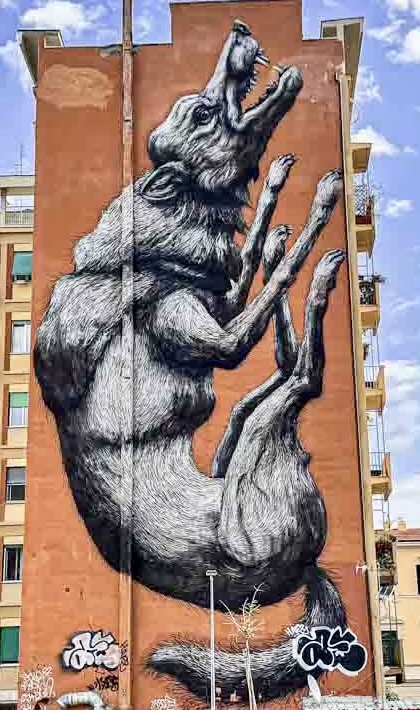
It is worth pausing on why a symbol this old still needed reimagining, and why it landed here, in a neighborhood shaped by an ancient mountain of broken amphorae, a nineteenth-century slaughterhouse and the vanished ground where the capital’s football club once played. Most cities let their oldest emblems calcify into decoration. Rome keeps finding new walls for hers.
The explanation begins, oddly, with an absence. By the early twentieth century, when football had already become a fixture of civic life across the Italian peninsula, Turin could claim its clubs, Milan could claim its clubs and then claim them again, and Genoa, older than most, had built an institution before most Italian cities had settled on a word for what a football club even was. Rome, the capital, the city every other Italian city had spent centuries measuring itself against, was in this one narrow respect behind.
It was not behind for lack of football. Rome already had a club founded in 1900, with its own colors, its own supporters and an established place in the capital. Roman, Alba-Audace and Fortitudo-Pro Roma occupied their own places in the city’s football landscape. What Rome lacked was a football institution conceived to represent the capital on the scale its political importance seemed to demand.
Rome, in other words, had football. What it did not yet have was Roma.
That changed in 1927, and there is no reason to make the circumstances prettier than they were. The effort to consolidate Roman football belonged explicitly to the Fascist political culture of the period. Italo Foschi, a Fascist official deeply involved in Roman sport, pursued the creation of a stronger club for the capital, one capable of challenging the more successful sides of northern Italy. Football was useful to a regime preoccupied with organization, spectacle and the symbolic importance of Rome.
The ambition did not stop with the three clubs that eventually merged. The older club was meant to be absorbed as well. It refused, choosing to remain separate rather than disappear into a consolidation it had not sought. Rome therefore emerged from an attempt at football unity with two clubs rather than one, an irony that has survived rather longer than the political project that produced it.
What Foschi and those around him did manage was the union of Alba-Audace, Fortitudo-Pro Roma and Roman, and the process, for all its historical consequence, was almost aggressively unromantic. There were negotiations, officials, institutional interests and paperwork. A name was chosen. Colors were adopted. Associazione Sportiva Roma took the field for the first time that year.
It is tempting, looking backward, to call this the beginning of Roma’s story. In the most literal sense, it was. There was no AS Roma before 1927. But almost everything that allowed the new club to look immediately as though it belonged to Rome was already there.
The name was ancient, the colors belonged to the city, and the wolf already belonged to Rome. Behind them stood a place that had spent an almost unreasonable amount of time accumulating meanings none of the men involved in the merger had created and no football club could reasonably claim as its own.
The club had no victories, no legends, no famous goals, no generations of supporters and no stories about itself for a grandfather to tell a child. It had not yet played at Campo Testaccio. There were no Scudetti to remember because there had been no seasons in which to win them. No player had worn the shirt long enough for the shirt to remind anyone of him.
There was not yet a Roma past.
There was, however, Rome.

For most football clubs, the order runs the other way. Significance accumulates as history does. Colors mean something because people keep wearing them. Grounds become sacred because people keep returning to them. A crest that once meant little beyond the institution itself acquires authority through victories, disappointments, family rituals and otherwise unremarkable Sunday afternoons. Give a club enough time and eventually the place and the institution become difficult to separate.
Roma was asked to begin somewhere near the end of that process.
It arrived carrying a name that already had rather more history than any football club could reasonably hope to acquire. La Lupa had been Roman for centuries beyond counting. She had been cast in bronze, carved into stone, reproduced in civic imagery and attached to the city’s founding mythology long before anyone thought to put her on a football shirt. The ochre and red belonged to Rome before anyone compressed them into a single word, giallorossi, a term supporters would eventually use not merely to describe a color scheme but themselves.
Roma did not have to spend generations teaching people what these things meant.
It had to discover what it would mean while carrying them.
There is something almost unfair about the arrangement. A new club ought to be allowed the modest expectations of a first season. Roma never really had that luxury. It had been assembled, quite deliberately, to represent the capital competitively, while an older and unabsorbed rival remained nearby, permanent evidence that the capital had not agreed to speak with one football voice. The new club was asked to create a history of its own while carrying an identity vastly older than itself.
Most clubs are permitted to become important gradually. Roma had to arrive that way, not because it had accomplished anything, but because Rome had.
Then Roma began doing the one thing no inheritance could do for it.
It began accumulating a history of its own.

Within two years, the club moved to Campo Testaccio, its first true home, beside a hill made from the discarded fragments of ancient amphorae. The juxtaposition is almost suspiciously convenient for an essay about Rome: a football club barely old enough to possess memories playing beside a landscape literally constructed from the remnants of another age. Yet Rome produces such collisions so routinely that they can pass without comment. The city does not arrange its periods neatly. It builds beside them, over them and sometimes directly out of them.
Campo Testaccio became one more layer.
Matches were played there, players became names worth remembering, supporters developed habits, and stories began passing from one person to another. By the time Roma left, the club possessed something it could not possibly have received in 1927: memories that belonged specifically to Roma.
The Roma of Campo Testaccio was not the Roma that won in 1942, just as that club was not the one that won in 1983 or 2001. Grounds and generations changed. Owners, presidents, sporting directors, coaches and players came and went. Rome changed around them too, acquiring new districts, roads, populations and arguments about what the city ought to become.
Rome was never handed intact from antiquity to the twentieth century. Republican Rome, Imperial Rome, Christian Rome, Papal Rome, the capital of unified Italy, Fascist Rome and the city that emerged afterward did not amount to one unchanging idea of Rome. They occupied much of the same ground while adding, abandoning, recovering and reinterpreting what came before. The remarkable thing about Rome is not that it finished becoming Rome early. It is that so many different Romes remain visible at once.
Roma entered that process too.
The wolf remained a symbol of Rome, but she also became something a child could see on a Roma shirt and associate with a parent, a match, a first trip to the Olimpico. Ochre and red remained colors of the city, but they also became the colors of scarves held above heads, shirts kept for decades and flags filling a curva. The name Roma remained infinitely larger than football, but on certain afternoons, saying it could mean something very specific.
Borrowing suggests that the thing ultimately belongs somewhere else. Inheritance asks something of the person who receives it. You take possession of something you did not create, add the evidence of your own years to it and, eventually, leave it to someone else.
Roma has now had nearly a century to do that.
Its football history now carries significance of its own. It has Campo Testaccio and the Olimpico, Scudetti and European nights, victories that altered families’ memories of entire years and defeats people still refuse to discuss without changing tone. It has songs, rituals, shirts, photographs, journeys and generations of Romanisti who have never known Rome without Roma in it.
Those things belong to the club.
And now they sit beside things that belonged to Rome first.
Which brings us back to Via Galvani.
ROA’s wolf is not the Capitoline Wolf. She is not suckling Romulus and Remus, not cast in bronze, not standing obediently on a plinth. She is enormous, skeletal and caught in motion, painted onto the side of an ordinary building in a neighborhood that has spent centuries being remade.
Nobody needs a plaque to explain why there is a wolf in Testaccio.
Rome had already done that work.
The artist changed the wolf without making her unrecognizable. The wall and the medium are modern. The neighborhood around her is not the Testaccio of antiquity, nor the Testaccio of the slaughterhouse, nor exactly the Testaccio in which Roma played.
An artist arrived in Rome in 2014 and painted an ancient Roman symbol in his own visual language on the side of a modern building, a short walk from the vanished football ground where a young club once began accumulating memories of its own. None of those things belongs to the same historical period. In Rome, they do not have to.
The city, the wolf, the colors, the name were all there.
Roma arrived afterward.
That does not make Roma ancient. It makes the distinction more interesting. The club was founded in 1927, in political circumstances that should be remembered rather than polished into legend. It began without a history of its own while carrying something that reached far beyond it.
Then it did what living institutions do.
It added its own.
Rome already had its history.
Roma gave that inheritance somewhere new to go.