Romanisti · Observation
The Ground Beneath Roma
Campo Testaccio disappeared. Somehow, Roma never entirely left.
There are places in Rome one visits to see what remains.
Campo Testaccio is a place one visits to consider what does not.
Walk along Via Nicola Zabaglia today and little announces that AS Roma once called this piece of ground home. The wooden stands are gone. The crowds are gone. The players whose names first gave the place meaning have long since disappeared.
Roma left more than eighty years ago.
The ground remains part of the club.
Most Romanisti alive today never stood inside Campo Testaccio. Neither did most of their parents. For many, even their grandparents would have known it principally through stories.
Still, the name requires little introduction.
Campo Testaccio.
Roma played there for eleven seasons. More than eight decades later, Campo Testaccio remains part of the club’s memory.

Rome is familiar with this arrangement.
Across the city, absence has a peculiar way of acquiring presence. Buildings disappear while their outlines remain. Ancient streets lie beneath modern ones. Fragments preserve the memory of structures otherwise lost. Places continue to be known by things that have not stood there for centuries.
In Rome, disappearance and erasure are not necessarily the same thing.
Campo Testaccio belongs to that pattern in its own smaller way.
It was never ancient. It was never monumental. It was a football ground made largely of wood, built for a club barely two years old.
It lasted eleven seasons.
That should have been enough time for Roma to use it.
Instead, it was enough time for Roma to remember it.
When Roma arrived at Campo Testaccio in 1929, there was not yet much Roma to remember.
The club was two years old.
Its history could still be measured in months rather than generations. There were no Scudetti to recall, no European nights to replay, no retired captains whose names belonged as much to the city as to the club. Most of what Romanisti would inherit had not happened yet.
Even the idea of home was unsettled.
Roma had played its earliest matches elsewhere before moving to the new ground in Testaccio. Wooden stands rose close to the pitch. Thousands of supporters could gather around a club still discovering what it meant to be Roma.
The first match came on 3 November 1929.
Roma beat Brescia 2–1.
There would be more consequential victories. What mattered was that they began accumulating in the same place.
Goals acquired locations. Players acquired corners of the ground from which they were remembered. Supporters returned by the same streets. Rituals formed through repetition. What had been new gradually became familiar.
This is one of the quiet ways a place becomes a home.
Campo Testaccio did not merely contain Roma matches. It provided somewhere for the young club to accumulate itself.

Roma played 170 competitive matches there and won 112 of them. In March 1931, Juventus arrived in Testaccio and lost 5–0. The victory became famous enough to escape football altogether, entering popular culture through the film Cinque a zero.
But another image may tell us more about the place.
Not everyone could afford to enter.
Some supporters climbed Monte Testaccio, the ancient mound nearby, and tried to watch from above. The view was imperfect. Only part of the pitch could be seen.
Still, they climbed.
A hill accumulated from the discarded amphorae of the ancient city became a vantage point for people trying to glimpse a football club founded two years earlier.
Below them was something new.
Beneath them were the remains of something unimaginably old.
Neither knew what it would one day become.
Then Roma left.
By 1940, Campo Testaccio no longer suited the needs of the club. The wooden ground that had helped give Roma a home belonged to an earlier stage of its life. The club moved on.
Institutions outgrow buildings. They replace facilities. They adapt to whatever the present requires. Decisions that later acquire enormous emotional significance can begin as matters of practicality.
Campo Testaccio was dismantled.
Roma continued.
New grounds produced new memories. New players arrived. In 1942 came the first Scudetto. Later generations would know the Stadio Olimpico, European nights, derbies, celebrations and disappointments.
But Campo Testaccio did something less predictable.
It stayed.
The ground disappeared, but its name continued to pass between generations. Supporters who had never entered its wooden stands learned what had happened there. Players who had never touched its pitch inherited its place in the story of the club. Eventually, memory began passing to people who could not possibly possess memories of their own.
In 1981, more than forty years after Roma had left Testaccio, the Curva Sud raised a message across the terraces:
Roma, Testaccio ti guarda.
The words reversed the usual relationship between supporter and ground.
Romanisti were not looking back at Campo Testaccio.
Campo Testaccio was looking at them.
By then, the old ground had become something more than a location. It had acquired the strange authority of an ancestor.
A place could no longer hold the club.
So the club began to carry the place.
Memory usually implies experience.
We remember what we saw, where we stood, what something sounded like before it disappeared.
Campo Testaccio complicates the word.
There are families in which a grandfather’s recollection became a father’s story and then a child’s inheritance. With each generation, the distance grows.
Eventually, no one will remember Campo Testaccio.
And Romanisti may remember it anyway.
A person can remember only a life.
A community can remember across generations.
It does so imperfectly. Details change. Stories acquire emphasis. Certain moments survive while others disappear. Myth begins to occupy the spaces that evidence leaves empty.
That does not necessarily make the inheritance false.
It makes stewardship of memory important.
Campo Testaccio survives because generations of Romanisti have decided that it belongs in the story they received and the story they pass forward.
They sing its name.
They reproduce its images.
They tell stories about the players who occupied it.
They remember Roma, Testaccio ti guarda, a banner raised by supporters who were already looking backward.
The inheritance accumulates.
This is familiar in Rome.
Individual memory is measured in decades. Rome’s is measured in centuries and millennia. Names survive the people who first spoke them. Stories remain attached to places after the physical evidence has disappeared. One generation receives fragments from another and decides what to carry forward.
Sometimes the fragment is marble.
Sometimes it is a story.
Sometimes it is the name of a football ground that disappeared before you were born.
Campo Testaccio is remembered by people who cannot remember it.
Perhaps that is not a contradiction.
Perhaps that is what inheritance looks like.
Return to Via Nicola Zabaglia.
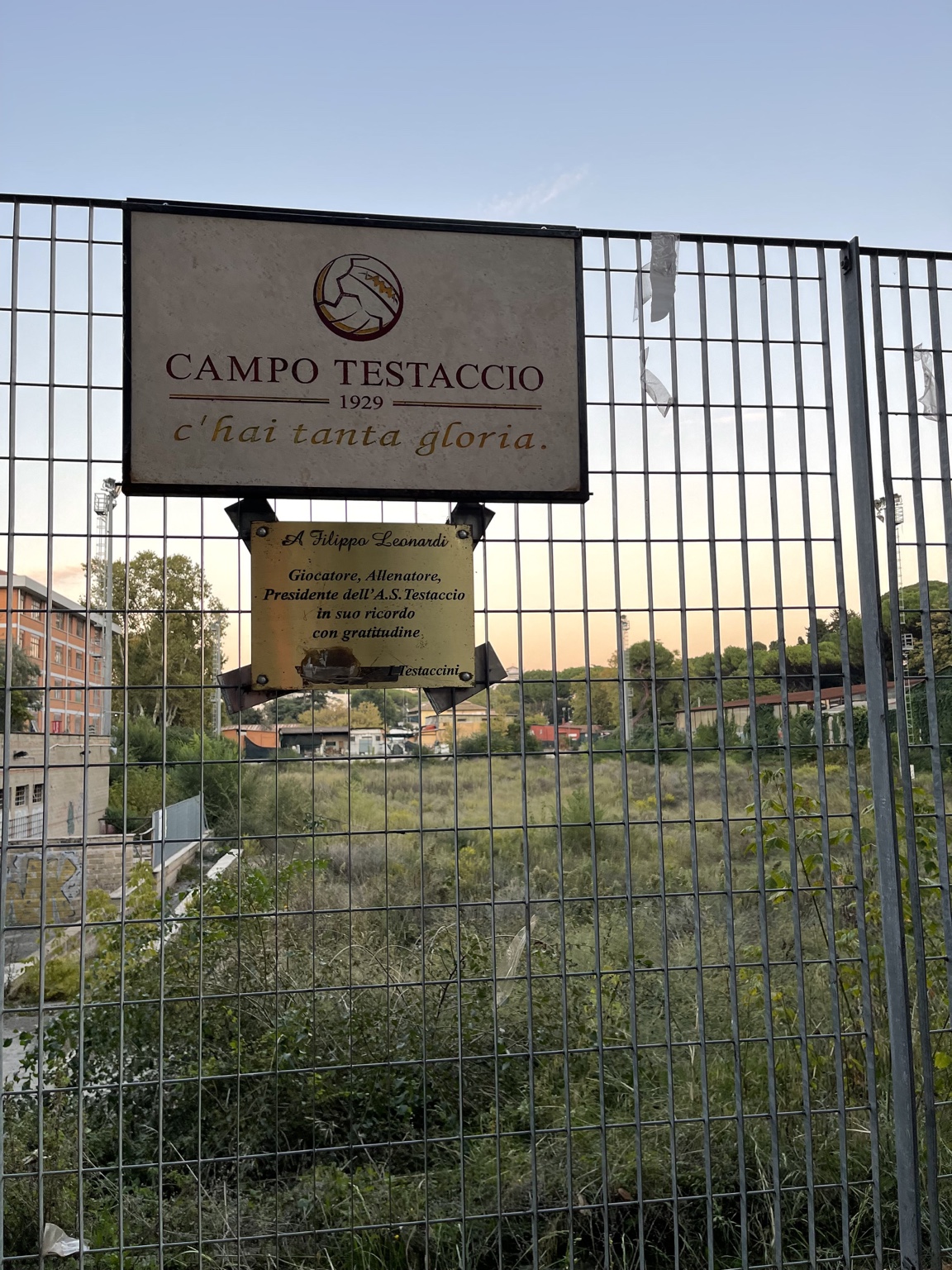
There is still no wooden grandstand waiting there. No crowd pressing toward the pitch. No match about to begin.
Campo Testaccio will not return simply because people remember it.
Nor should memory require that.
Rome would be unrecognizable if every generation attempted to reconstruct everything the previous one had lost.
Not everything must remain unchanged to remain present.
Campo Testaccio lasted eleven seasons.
That was enough.
Enough for a young club to learn what home felt like. Enough for supporters to attach memory to a piece of ground. Enough for stories to begin moving from one generation to another.
The players left.
The stands disappeared.
The matches ended.
The place remained.
Not as it was.
As something carried.
Romanisti can feel the loss of a ground they never entered. They are not remembering their own experience. They are recognizing an inheritance.
Home does not always mean where you are.
Sometimes it means where you learned who you were.
For Roma, one of those places is still in Testaccio.
You can go there.
There is remarkably little to see.
That may be the point.
Buildings disappear. Generations disappear. Football grounds disappear.
Place is more stubborn.